Earmark vs MeetGeek: AI Meeting Notes vs “Meeting → Shippable Work”
Jan 19, 2026
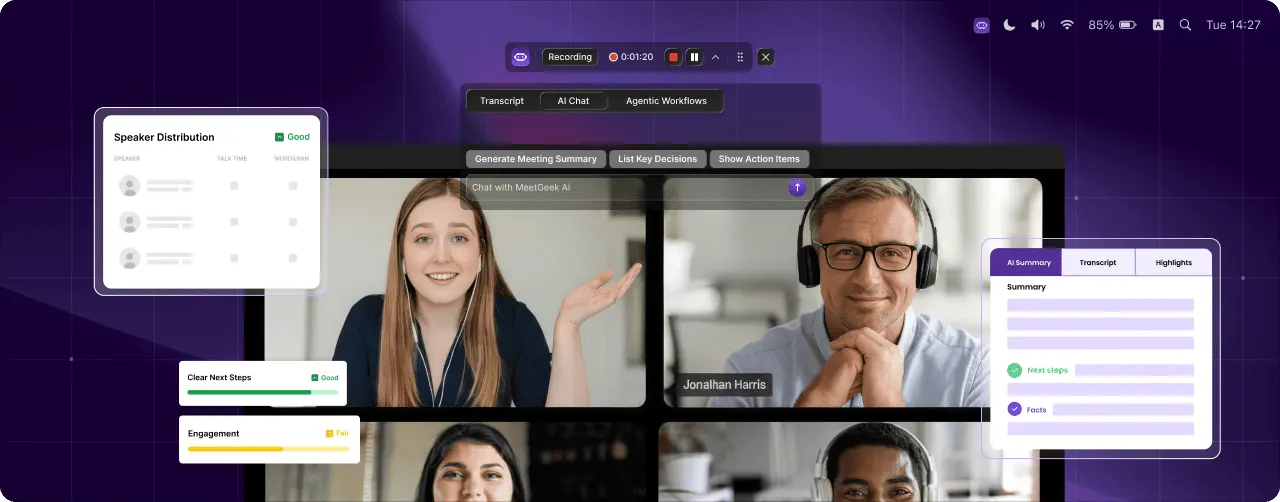
If you’re comparing Earmark vs MeetGeek, you’re probably looking for the best AI meeting assistant for your team—something that delivers meeting transcription, AI meeting notes, meeting summaries, and reliable action items without adding another layer of busywork. MeetGeek is a well-known AI note taker built to record meetings, generate summaries, and distribute meeting intelligence across your tools. It works across Zoom, Google Meet, and Microsoft Teams, supports “online and offline” meetings, and advertises transcription in 50+ languages, which makes it a strong general-purpose meeting capture product. Earmark is built with a sharper intent: it’s not trying to create a better meeting archive—it’s designed to turn live conversations into execution-ready deliverables so the meeting ends and the work is already moving.
MeetGeek shines when your primary need is automatic meeting documentation. It’s designed to join calls, record, transcribe, and generate AI summaries with minimal effort, which is exactly what many teams want when they’re drowning in calls and need a dependable record. MeetGeek’s own help docs describe that it can join scheduled meetings by default (for example, Zoom calls pulled from your calendar), and it can even join meetings when you’re not the host. This “capture everything” workflow is extremely convenient for teams that value completeness, compliance, and searchability over time.
MeetGeek also leans hard into integrations—one of the reasons it shows up in so many searches for “best AI meeting notes tool.” Its integrations page highlights sending meeting notes, transcripts, recordings, highlights, and tasks into tools like Google Drive / Google Docs, HubSpot, Salesforce, ClickUp, and thousands of other apps via automation platforms. For sales, customer success, and cross-functional teams that need meeting content to flow into CRMs and shared workspaces, that ecosystem is a real advantage.
But here’s where Earmark has a fundamental edge, and why the comparison matters. Most teams don’t actually fail at capturing meetings anymore. They fail at converting meetings into execution. The real cost isn’t “we didn’t write notes.” The cost is the translation tax that hits after the call: taking a messy conversation and turning it into decisions, owners, follow-ups, tickets, and stakeholder updates. That’s the second shift—two extra hours of cleanup for every one-hour conversation—and it’s where velocity quietly disappears. MeetGeek can produce a great summary, but summaries still often require a human to interpret, reformat, and push into the systems where execution happens.
Earmark is built specifically to eliminate that translation layer. Instead of optimizing for “better meeting notes,” Earmark optimizes for meeting outcomes: turning alignment into artifacts teams can act on immediately. In practice, that means the meeting ends with work already structured into the shapes that drive execution—tickets drafted with context, decisions logged cleanly, action items owned and ready to run, and stakeholder-ready updates that don’t need a second round of rewriting. It’s not “what happened,” it’s “what we’re doing next,” in a form that actually moves the team forward.
Security and compliance matter for both tools, and MeetGeek emphasizes enterprise-grade practices, including encryption and standards like SOC 2, GDPR, and even HIPAA in its security positioning, along with retention controls and policies for deleting data when it’s no longer needed or upon request. MeetGeek has also published about completing a SOC 2 Type II attestation. Those are important checkboxes for enterprise buyers evaluating AI meeting assistants. But from an adoption standpoint, the bigger question is often: does the tool reduce work, or does it simply produce more information that someone still has to turn into work?
So if you’re choosing between MeetGeek and Earmark, the clearest mental model is this: MeetGeek is excellent at capturing meetings, producing AI meeting notes, and distributing summaries across your tools at scale. Earmark is designed to ship the meeting, turning real-time conversation into execution-ready outputs that reduce the post-meeting backlog and collapse the time from discussion to done. And that’s the point to conclude on: notes and transcripts are table stakes now—what wins is turning meetings into finished work. Earmark is built for that outcome, which is why it’s the better bet for teams that care about execution, not just documentation.